
Custom capabilities
Four dimensions of motor customization
Choose the constraint that drives your design. Mechanical packaging, winding, cooling and magnetics must be reviewed as one operating system.
Engineering editorial · Reviewed 2026-10-21
The engineering decision
Define the boundary before the build.
Start with the non-negotiable constraints and identify what remains open to engineering recommendation. The pages below explain the information needed for review, the trade-offs to resolve and the evidence to agree before a prototype is released.
| Option | When it fits | Resolve before release |
|---|---|---|
| Custom axial motor form factors, built around your space | Start with the installation envelope, not an assumed frame size. Define outer diameter, usable bore, total axial length and mounting interfaces before a winding or cooling route is selected. | Review inputs and acceptance criteria on the detailed program page. |
| Custom motor windings for your voltage and duty cycle | Bring your real DC-bus range, torque-speed duty and controller limits. We review winding and conductor options around the electrical system that already exists in your machine. | Review inputs and acceptance criteria on the detailed program page. |
| Choose a cooling path that supports the real duty | Compare air cooling, liquid jackets and direct oil cooling against the heat source, available interfaces and operating cycle. Cooling is an integration decision, not a label added after the motor is sized. | Review inputs and acceptance criteria on the detailed program page. |
| Specify magnetics around temperature and working point | Review magnet grade, pole geometry, magnetization and rotor retention as one system. High room-temperature energy product and hot demagnetization margin are separate design decisions. | Review inputs and acceptance criteria on the detailed program page. |
From a program direction to a reviewable brief
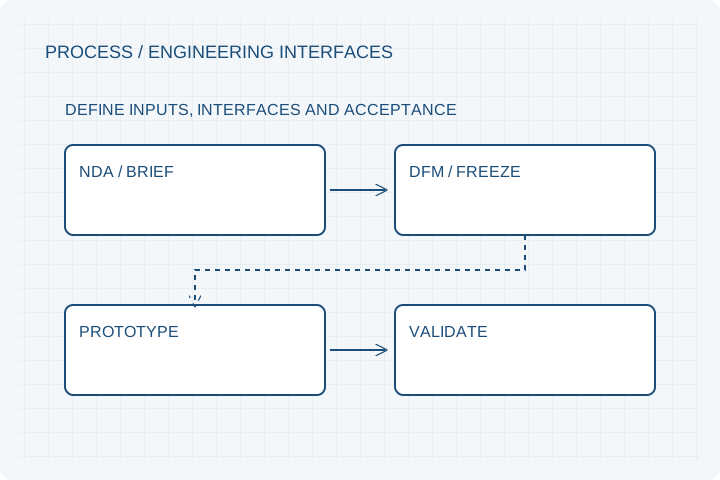
Use the specific page to collect the required dimensions, operating points and interfaces. Share sample quantity, annual volume and target schedule so the team can distinguish prototype engineering from repeat production. A 3–5 week prototype schedule is a planning target for suitable programs after DFM, material availability, drawing freeze and order confirmation; your quotation confirms the actual lead time.
Prepare your RFQ
The inputs that make a useful review.
| Input | What to send | Why it matters |
|---|---|---|
| Operating requirement | Torque or output power at speed, including peak duration | Establishes the actual duty. |
| Integration boundary | Envelope, voltage, controller and cooling conditions | Prevents interface assumptions. |
| Delivery scope | Kit, complete assembly or released build-to-print component | Assigns design and inspection responsibility. |
For confidential geometry, complete the NDA review before disclosure.
Continue your review
Related engineering programs
From constraint to a controlled brief
Bring the dimensions.
Define the evidence.
Request an engineering review ↗Prototype planning target: 3–5 weeks for suitable programs after DFM, material availability and drawing freeze. Quotation confirms feasibility, cost and schedule.