
Custom capabilities
Custom axial motor form factors, built around your space
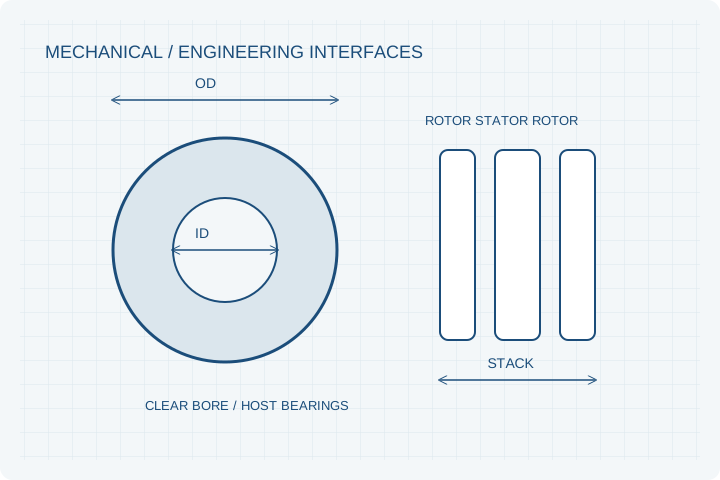
Start with the installation envelope, not an assumed frame size. Define outer diameter, usable bore, total axial length and mounting interfaces before a winding or cooling route is selected.
Engineering editorial · Reviewed 2026-10-21
The engineering decision
Define the boundary before the build.
A short magnetic stack can still become a long installed motor once bearings, end plates, seals, connectors and assembly clearances are included. For frameless kits, the surrounding machine becomes part of the motor system. Our review separates the electromagnetic envelope from the installed envelope so the prototype is evaluated against the space the assembly really has.
| Option | When it fits | Resolve before release |
|---|---|---|
| Frameless disc kit | Your machine supplies the bearing, housing and cooling interfaces. | Assign air-gap control, concentricity and rotor retention responsibilities. |
| Hollow-shaft assembly | Cables, hoses or optics need a protected route through the center. | Check the full clear bore with connectors, shaft wall, bearings and bend radius. |
| Enclosed pancake motor | You need a defined shaft, flange and enclosure interface. | Specify total installed length, cable exit and the required ingress test. |
Separate hard limits from preferences
Mark maximum installed diameter and length as hard limits, then identify dimensions that can move. A section drawing should show the shaft, bearings, fastening access and cable exit. This lets engineering compare an enclosed motor with a frameless kit without quietly transferring packaging volume into the host machine.
Control the gap through the assembly
An axial gap is influenced by the complete tolerance chain, including bearing locations, rotor flatness, mounting datums and structural deflection. Specify the assembled reference condition and inspection method. A room-temperature part dimension does not establish running clearance under load and heat.
Prototype the interfaces that carry risk
A first article can prioritize fit, connector clearance and assembly access before a full loaded test campaign. State which checks are exploratory and which are release criteria. Changes to shaft or flange geometry need review for retention, bearing loads and tooling reuse.
Prepare your RFQ
The inputs that make a useful review.
| Input | What to send | Why it matters |
|---|---|---|
| Envelope drawing | OD, ID and total installed length with tolerances | Separates hard limits from dimensions that can move. |
| Mounting and loads | Flange datum, bearing arrangement, axial/radial loads | Prevents the thin motor package from becoming an unsupported bearing design. |
| Shaft and services | Shaft detail, usable bore, cable routing and connector position | Avoids interference during assembly and maintenance. |
| Operating environment | Temperature, dust, moisture and cleaning exposure | Determines the sealing and corrosion assessment. |
| Duty and cooling | Continuous/peak torque at speed and available cooling | Checks that the envelope can support the requested thermal load. |
For confidential geometry, complete the NDA review before disclosure.
Continue your review
Related engineering programs
Questions before you specify
How thin can a custom pancake motor be?
The answer depends on torque, bore, bearings, cooling and insulation. Send the installed-length limit rather than just a preferred magnetic-stack thickness; the review identifies the dimensions that constrain the design.
Does frameless mean a finished joint actuator?
No. A frameless motor is a stator/rotor delivery boundary. Bearings, load support, housing, encoder, controller and any reduction stage must be assigned in the project scope.
Can the enclosure be designed for IP67?
IP67 can be an enclosure target. Shaft seals, cable entries, pressure equalization and the test assembly must be defined; a design target is not a certified rating.
Can the shaft and flange change without new motor tooling?
Sometimes. We first check whether an existing electromagnetic stack can remain unchanged. Shaft or housing machining changes can still affect bearings, balance, sealing and validation.
From constraint to a controlled brief
Bring the dimensions.
Define the evidence.
Request an engineering review ↗Prototype planning target: 3–5 weeks for suitable programs after DFM, material availability and drawing freeze. Quotation confirms feasibility, cost and schedule.