
Custom capabilities
Specify magnetics around temperature and working point
Review magnet grade, pole geometry, magnetization and rotor retention as one system. High room-temperature energy product and hot demagnetization margin are separate design decisions.
Engineering editorial · Reviewed 2026-10-21
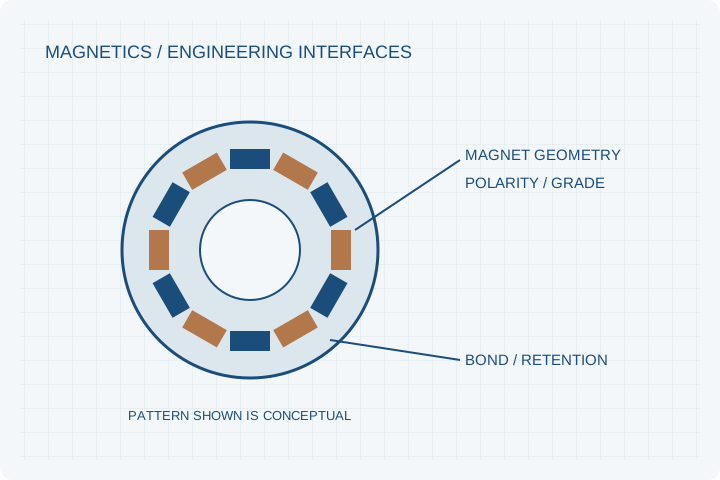
The engineering decision
Define the boundary before the build.
Choosing the highest grade number can miss the actual failure boundary. Magnet thickness, air gap, opposing armature field, temperature and geometry change the working point. Segmentation, skew and Halbach arrangements also add assembly and inspection requirements; they are not interchangeable cosmetic options.
| Option | When it fits | Resolve before release |
|---|---|---|
| High-energy NdFeB | Compact geometry makes magnetic loading a key constraint. | Check the specific grade curve, temperature, coating and availability. |
| High-coercivity NdFeB or SmCo | Hot operation or an opposing field drives the material decision. | Compare the relevant hot curves, geometry, corrosion and mechanical requirements. |
| Segmented / skewed / Halbach rotor | Field distribution, torque ripple or rotor loss motivates a specific layout. | Define magnetization directions, positioning, bonding and field verification. |
Use the full grade designation
An energy-product designation such as N52 is not a promise of high-temperature operation. Compare the full supplier grade, demagnetization curves and working point for the actual magnet geometry. Short-circuit or fault conditions may require additional review beyond the normal operating temperature.
Choose magnetic and mechanical interfaces together
Magnet coating, adhesive, bond-line thickness and retention features affect assembly and durability. Specify the magnetization direction, inspection state and whether assembly occurs before or after magnetization. The completed rotor needs its own runout, balance and speed acceptance requirements.
Treat an array as a field specification
A Halbach layout requires defined magnetization vectors, segment geometry and a measurable field requirement. Appearance alone does not confirm the pattern or flux distribution. Include a polarity map and the measurement plane so the incoming inspection can establish what was delivered.
Prepare your RFQ
The inputs that make a useful review.
| Input | What to send | Why it matters |
|---|---|---|
| Magnetic target | Pole count, magnet geometry and required flux/field map | Connects the drawing to a measurable magnetic result. |
| Temperature and fault duty | Hot working point, peak current and demagnetization scenarios | A material temperature class is not a motor rating. |
| Grade and coating | Supplier grade/datasheet, coating and corrosion exposure | Avoids substituting a similar-looking magnet with different properties. |
| Assembly drawing | Magnetization vector, gaps, adhesive and datum scheme | Controls polarity and position during a difficult assembly. |
| Mechanical duty | Maximum speed, shock, retention and balance targets | Makes magnetic and structural release decisions consistent. |
For confidential geometry, complete the NDA review before disclosure.
Continue your review
Related engineering programs
Questions before you specify
Can N52–N56 be requested?
Yes, as a sourcing target rather than a blanket stock or hot-performance promise. A specific geometry, supplier grade and operating point need confirmation; a high energy-product grade is not automatically a high-temperature grade.
Are SH, UH and EH all suitable for 200°C?
No. In the cited Arnold tables, example SH, UH and EH classes differ. Use the exact supplier curve and operating point; a material designation does not establish the continuous motor temperature.
Does a Halbach layout remove the need for back iron?
It depends on the field objective and structural design. Field concentration, leakage, losses, cost and retention must be compared for the actual geometry, rather than assuming one universal benefit.
Can a photograph confirm the magnetic layout?
No. A photograph can show visible segmentation but cannot verify magnetization vectors, grade or field performance. Those need drawing and test evidence.
Further technical reading
Primary references for architecture or material context; these sources do not validate our project-specific performance.
From constraint to a controlled brief
Bring the dimensions.
Define the evidence.
Request an engineering review ↗Prototype planning target: 3–5 weeks for suitable programs after DFM, material availability and drawing freeze. Quotation confirms feasibility, cost and schedule.