
Prototyping & quality
A prototype plan with defined evidence at every gate
Agree the design inputs, manufacturing responsibilities and acceptance evidence before the first sample. A prototype should answer a defined engineering question, not simply prove that parts can be assembled.
Engineering editorial · Reviewed 2026-10-21
The engineering decision
Define the boundary before the build.
Prototype schedules become unreliable when drawing changes, material procurement, tooling and validation are hidden inside one lead-time number. We separate the gates and record what each sample is intended to establish. A 3–5 week target can be considered for suitable programs after DFM, materials, drawing freeze and order confirmation; the quotation defines the actual commitment.
| Option | When it fits | Resolve before release |
|---|---|---|
| Build-to-print sample | The customer supplies a controlled design and acceptance plan. | Clarify drawing gaps and manufacturing changes before the purchase order. |
| Joint engineering prototype | Design choices still need coordinated review. | Separate analysis, manufacturing, validation and sign-off responsibilities. |
| Production-intent sample | The route is close to the planned repeatable production process. | Control material alternatives, tools, fixtures and revision release. |
Five gates, with a clear handoff
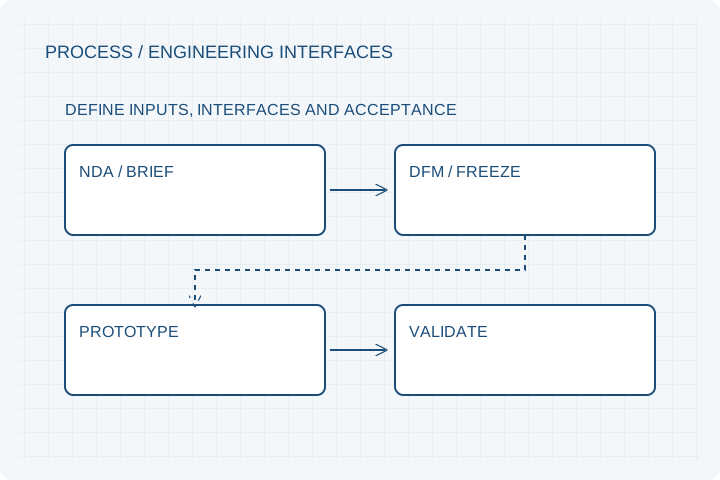
Confidentiality and brief → DFM and material review → drawing freeze and sample route → inspection and agreed functional validation → production-intent release. Each gate has an owner, an input revision and a defined output; a passed fit check does not automatically close thermal or loaded-performance acceptance.
Prepare your RFQ
The inputs that make a useful review.
| Input | What to send | Why it matters |
|---|---|---|
| Design baseline | Revisioned drawings, models, BOM and open issues | Keeps every sample linked to the design it actually represents. |
| Prototype objective | Fit, winding, thermal, magnetic or loaded-performance question | Prevents one sample being assumed to validate all future production. |
| Acceptance plan | Conditions, limits, fixtures, sample count and report format | Makes approval objective and reproducible. |
| Material and tools | Grade availability, soft/hard tool choices and NRE | Exposes schedule drivers before promising a delivery date. |
| Release responsibility | Customer/supplier design, inspection and change-control ownership | Avoids unassigned sign-off between engineering and procurement. |
For confidential geometry, complete the NDA review before disclosure.
Continue your review
Related engineering programs
Questions before you specify
Is the first response a final quotation?
The first response acknowledges the brief and identifies missing inputs. A firm cost and schedule depend on the manufacturing route, materials, quantities, testing and commercial terms.
What should a dynamometer report state?
Motor and controller configuration, bus/current conventions, cooling, instrumentation, calibration references, operating points and test duration should be identified. A bare curve is not a complete acceptance record.
When should hard tooling begin?
After the design and process risks that the prototype was meant to resolve are closed, and the drawing, forecast, acceptance plan and NRE are agreed.
How are engineering changes handled?
Use a controlled revision request with the affected parts, effective lot, cost/schedule impact and validation consequences. A photo or informal message should not silently replace a released drawing.
From constraint to a controlled brief
Bring the dimensions.
Define the evidence.
Request an engineering review ↗Prototype planning target: 3–5 weeks for suitable programs after DFM, material availability and drawing freeze. Quotation confirms feasibility, cost and schedule.