
Build-to-print components
Coreless stator winding and epoxy-potting programs
Define the coil, resin system and heat path together. Coreless stator programs begin with conductor placement and electrical acceptance, then turn those requirements into a controlled potting and inspection plan.
Engineering editorial · Reviewed 2026-10-21
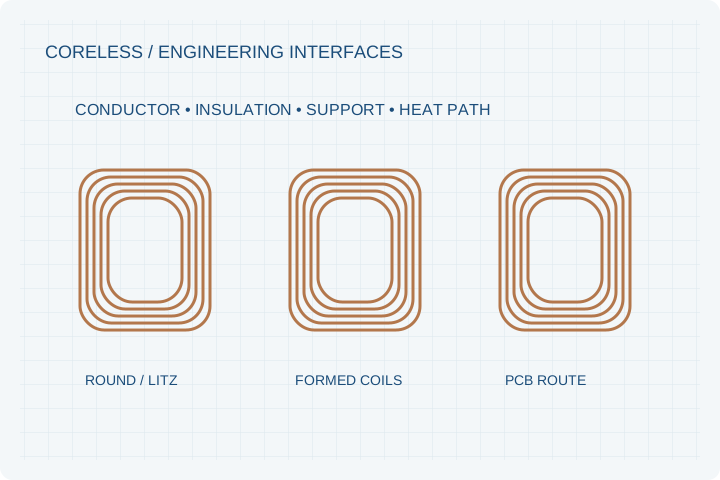
The engineering decision
Define the boundary before the build.
Removing the toothed iron changes both magnetic behavior and structural support. The resin, coil fixture, termination design and neighboring cooling structure must carry loads and remove heat. A clean external surface does not prove internal void control, cure quality or electrical insulation.
| Option | When it fits | Resolve before release |
|---|---|---|
| Wound coreless coil assembly | The customer needs a coil shape and termination before final encapsulation. | Agree placement tolerances, handling support and electrical test state. |
| Vacuum-potted stator program | Encapsulation is part of the electrical and mechanical design. | Specify resin, cure process, acceptable void criteria and dimensional datum. |
| Thermally integrated stator | A carrier or housing forms a deliberate heat-removal path. | Review electrical isolation, thermal interfaces and differential expansion. |
The support structure is part of the stator
Removing an iron core changes the winding support and thermal path. Define coil location, stiffness, conductor exit and the surfaces that transfer heat. A resin cast that looks complete externally can still require internal void and electrical checks.
Specify resin properties in context
Provide expected temperatures, coolant or chemical exposure, electrical insulation requirements and allowable distortion. Resin selection includes cure behavior and compatibility with wire insulation and terminals. Do not substitute an adhesive or potting material solely because its nominal temperature label appears similar.
Inspect before and after potting
Check coil resistance, insulation and position before encapsulation, then repeat the agreed electrical checks after cure. Define dimensional acceptance, void-inspection method and traceability. A sacrificial section or process coupon can be included when the quality plan requires evidence that cannot be observed externally.
Prepare your RFQ
The inputs that make a useful review.
| Input | What to send | Why it matters |
|---|---|---|
| Winding definition | Turns, conductor, coil layout and termination drawing | Avoids geometry that cannot be reproduced or inspected. |
| Resin specification | Temperature, chemical exposure and electrical requirements | Prevents potting from being selected only by appearance. |
| Support and thermal path | Carrier interfaces, clamping and cooling boundary | Defines how an ironless winding survives operation. |
| Electrical acceptance | Resistance, inductance, insulation and temperature reference | Creates objective release conditions for the sub-assembly. |
| Inspection plan | Void/defect criteria, samples and allowed destructive checks | Aligns cost with the level of internal evidence required. |
For confidential geometry, complete the NDA review before disclosure.
Continue your review
Related engineering programs
Questions before you specify
Does coreless mean zero starting resistance?
It can remove cogging associated with toothed iron. Bearings, seals, electromagnetic load and other losses remain; a complete generator or motor still needs a defined starting-torque test.
Can resin alone provide the cooling solution?
No. Resin properties and thickness are only part of the heat path. The carrier, housing, coolant boundary and electrical duty must also be considered.
Can I choose an epoxy by temperature rating alone?
The review also needs thermal expansion, thermal conductivity, dielectric properties, adhesion and chemical compatibility. A catalog temperature value does not establish the life of the assembled stator.
Do the available photographs prove resin-stator capability?
No. A coil or generator photograph does not prove vacuum-potting parameters or an offered resin system. This page uses an original construction schematic; actual sample evidence belongs in the project review.
From constraint to a controlled brief
Bring the dimensions.
Define the evidence.
Request an engineering review ↗Prototype planning target: 3–5 weeks for suitable programs after DFM, material availability and drawing freeze. Quotation confirms feasibility, cost and schedule.