
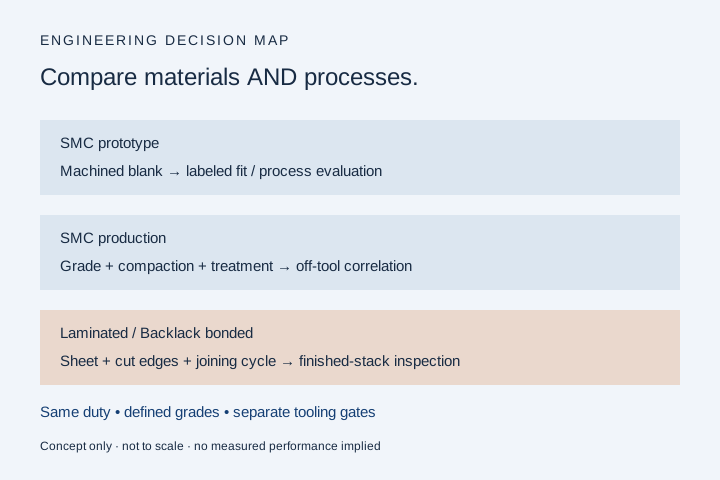
Choose the manufacturing route with the magnetic model
Start with flux direction, duty spectrum, mechanical interfaces and annual demand. A design that relies on three-dimensional flux paths may justify an SMC review; a thin-sheet route may suit a different loss and geometry balance. Neither material family is universally more efficient. Compare the selected grade at the same flux-density waveform, frequency and temperature, then add assembly and copper losses separately.
Separate three routes that are often conflated
Höganäs describes Somaloy soft magnetic composites as a three-dimensional-flux material technology. Its dedicated prototyping material has its own machining guidance. voestalpine describes Backlack as a bonding route for electrical-steel stacks, with process conditions tied to component geometry. These source statements identify material/process distinctions; they do not establish the grades, tooling or tolerances available in our quotation.
| Route | Useful review question | Do not assume |
|---|---|---|
| SMC machined prototype | Can a blank establish geometry, winding clearance and assembly access? | That a machined prototype duplicates pressed-production losses or strength |
| SMC pressed production | Is the geometry compatible with compaction, ejection and the selected heat treatment? | That every thin feature or undercut can be pressed without redesign |
| Laser / stamped laminated stack | How will sheet orientation, joining and edge damage affect the design? | That nominal sheet data describes the completed stack |
| Backlack bonded laminations | What coating, pressure, thermal cycle and fixture produce the stack? | That Backlack is a separate bulk magnetic alloy |
Build a comparison from actual grade data
Request a grade/revision-specific data package and distinguish typical values from guaranteed acceptance limits. Store conditions next to the numbers. A single permeability, saturation or strength figure is insufficient to rank an SMC family against a laminated assembly. The required model data may also depend on flux orientation and local waveform.
| Data item | SMC review | Lamination / bonded-stack review |
|---|---|---|
| Magnetic model | B–H curve and loss curves for stated density and heat treatment | Sheet grade, thickness, rolling orientation and post-process condition |
| Mechanical integrity | Density, strength test method, edge/feature fragility | Stack strength, joining integrity, flatness and bond temperature exposure |
| Thermal model | Direction-dependent assembly thermal path and contact interfaces | Interlaminar coating/bond resistance, stack direction and mount contact |
| Traceability | Powder/blank grade, lot and processing revision | Coil/heat, coating, cutting method and joining recipe |
Prototype route: answer a specific question before hard tooling
Höganäs publishes a separate SPM machining guide and describes both machined and off-tool prototypes. Ask which question the sample answers: fit only, winding process, magnetic behavior, or production-process correlation. Label the material/process on the prototype report. If the final core is pressed, schedule a comparison with an off-tool sample before the motor performance claim is transferred to production. Primary technical reference ↗
Backlack DFM: qualify the bonded assembly
voestalpine states that bonding conditions depend on component size and the backing fixture, and that bond strength depends on factors including layer thickness and the test method. Freeze sheet/coating identification, handling, nesting/cutting, fixture pressure, thermal history and the inspection method as one process. A stack that is flat before a thermal cycle may need a second check afterward. Do not prescribe a generic cure temperature from another grade. Primary technical reference ↗
Use stage gates to control redesign and tooling exposure
This matrix is a proposed procurement framework, not a stock tooling list or a zero-NRE offer. Obtain separate prices for samples, fixtures, production tools, inspection development and recurring parts.
| Stage | Decisions to freeze | Evidence before the next commitment |
|---|---|---|
| Prototype | Envelope, winding assembly and provisional material route | Dimensioned sample plus material/process label and agreed limited test scope |
| Pilot | Production-intent grade, tooling route and critical characteristics | Off-tool or process-equivalent correlation, repeatability and revised loss model |
| Series | Drawing revision, approved process, capacity plan and inspection plan | Signed release, lot traceability, tool ownership/maintenance and change control |
Scenario: a 12-piece fit study is not a loss guarantee
Illustrative planning scenario: a laboratory needs twelve cores to check bobbin access and housing assembly. A machined prototype route may answer those fit questions without a production die, subject to material availability and geometry review. Its report should state that the sample is for fit evaluation. If the next gate is dynamometer efficiency, arrange material/process-correlated magnetic data or production-intent samples; do not relabel the fit batch as a validated performance build.
Scenario: a flat stack can still fail after joining
Illustrative scenario: a bonded stator passes a pre-cure dimensional check but shifts after cure or customer fastening. Re-check final installed datums and record the process revision before reducing drawing tolerances. The corrective action may involve fixture support, thermal uniformity or assembly load rather than tighter incoming sheet thickness. Confirm with a controlled trial; no measured result is asserted here.
Send a route-neutral RFQ when you need a fair comparison
Supply 3D geometry and a datum-controlled drawing, active flux directions, operating frequency spectrum, allowable envelope, winding interfaces, insulation needs, temperature history and sample/annual quantities. Request two route-specific DFM responses against the same critical-characteristic list. Identify what is still unknown and the cost to resolve it. Actual grade availability, as-built losses, allowable geometries and cycle times remain quotation/validation items.