
Engineering resources
Pancake and disc motor selection guide
Pancake, disc, disk, flat and printed-armature are overlapping search terms. Identify the architecture before comparing drawings or requesting a quotation.
Engineering editorial · Reviewed 2026-10-21
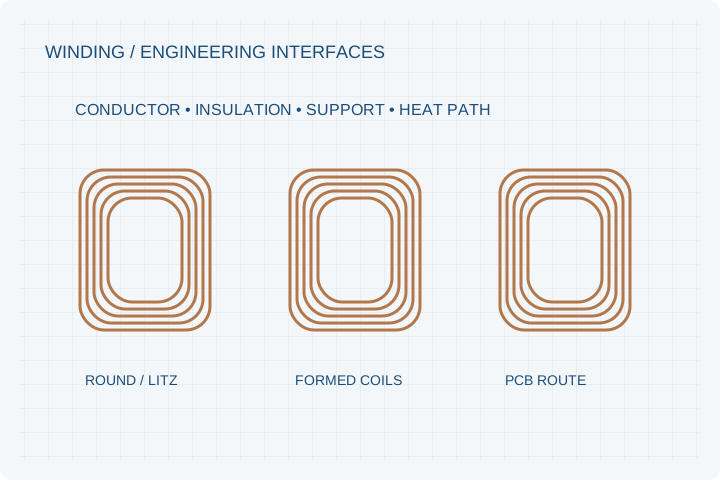
The engineering decision
Define the boundary before the build.
A search for a flat motor can return brushed printed-armature motors, brushless iron-core motors, coreless disc machines and compact cylindrical designs. The visible shape does not establish how the motor is commutated, how it is cooled or whether it is suitable for a precision joint.
| Option | When it fits | Resolve before release |
|---|---|---|
| Pancake / flat motor | Useful form-factor terms for shallow packages. | Confirm active and installed dimensions, flux direction and commutation. |
| Printed armature / PCB stator | Refers to a conductor construction or armature route. | Clarify rotating versus stationary conductors and brushed versus brushless operation. |
| Coreless / ironless disc motor | Highlights the absence of a conventional iron core in the active winding. | Confirm support, heat removal, inductance and current-ripple requirements. |
Use synonyms to find suppliers, then use specifications
Disc and disk are spelling variants, while axial field and axial gap often describe the working field or gap orientation. Use these expressions during research, then put the exact topology, winding construction and delivery scope in the RFQ.
Printed does not guarantee PCB equivalence
Printed-armature terminology has historical uses beyond modern PCB stators. A brushed disc armature is not interchangeable with a stationary multilayer PCB winding driven by an inverter. Request a section drawing and connection schematic.
Frameless describes delivery scope
A frameless motor kit omits the completed bearing and housing system. It can reduce integration constraints but transfers responsibilities to the host machine. Include runout, concentricity, air-gap and thermal-contact requirements in the handoff.
Avoid a shape-only request
Instead of asking for a pancake motor, send a maximum OD/ID/length, continuous torque at speed, peak duration, bus range and cooling conditions. Add a section sketch if available. These inputs permit a practical comparison of alternative architectures.
Prepare your RFQ
The inputs that make a useful review.
| Input | What to send | Why it matters |
|---|---|---|
| Architecture | Brushed/brushless, rotor count, stator type and feedback | Makes apparently similar search results comparable. |
| Mechanical package | OD, clear bore, thickness, bearing and housing scope | Checks the complete installation. |
| Electrical interface | Bus range, controller and continuous/peak current | Avoids treating a voltage label as a full drive specification. |
| Duty and validation | Torque-speed cycle, cooling and required evidence | Supports a meaningful rating and acceptance plan. |
For confidential geometry, complete the NDA review before disclosure.
Continue your review
Related engineering programs
Questions before you specify
Are axial field and axial flux synonyms?
They are useful related search expressions, but confirm the actual motor cross-section and flux path for the product being discussed.
Should I search axial filed?
Axial filed is generally a misspelling of axial field. Research can capture the typo, but published engineering content should use the correct term.
Can a coreless motor use a controller designed for an iron-core motor?
Compatibility depends on resistance, inductance, current ripple, feedback and control settings. Review the complete motor-drive combination.
Further technical reading
Primary references for architecture or material context; these sources do not validate our project-specific performance.
From constraint to a controlled brief
Bring the dimensions.
Define the evidence.
Request an engineering review ↗Prototype planning target: 3–5 weeks for suitable programs after DFM, material availability and drawing freeze. Quotation confirms feasibility, cost and schedule.