
Engineering resources
Axial flux vs radial flux: packaging decisions
Compare flux direction, installation envelope and thermal interfaces before choosing a topology. A short motor package is only one part of the decision.
Engineering editorial · Reviewed 2026-10-21
The engineering decision
Define the boundary before the build.
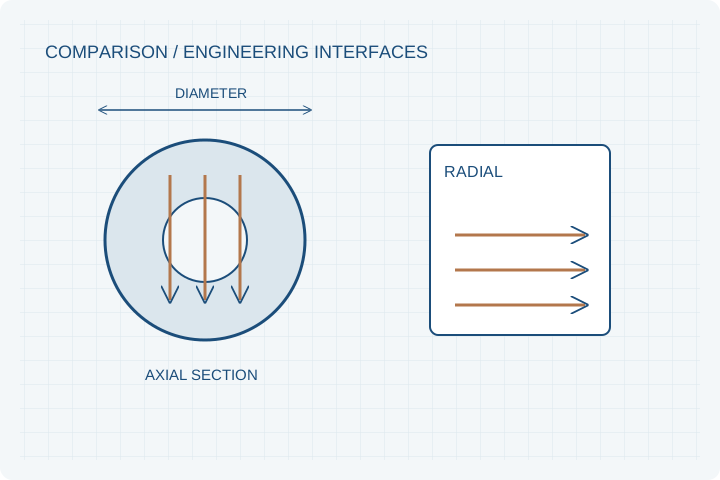
Axial flux and radial flux describe the direction of the working magnetic flux through the air gap relative to the rotation axis. They do not, by themselves, establish efficiency, continuous torque, manufacturing cost or system mass. Compare designs at the same operating points and boundary conditions.
| Option | When it fits | Resolve before release |
|---|---|---|
| Axial flux | Disc geometry may suit a shallow, larger-diameter space. | Check axial attraction, rotor stiffness, air-gap control and usable diameter. |
| Radial flux | Cylindrical geometry may fit a longer, smaller-diameter space. | Check radial package, end windings, shaft arrangement and cooling. |
| Frameless integration | Either topology can be supplied without a complete housing. | Assign bearings, installation tolerances and thermal contact to the system. |
Topology is not a performance certificate
Dual-rotor, single-sided, yokeless, iron-core and coreless designs distribute flux, conductors and structure differently. A topology name cannot replace a measured torque-speed map. Ask how the quoted point was cooled and for how long it was sustained.
Diameter and length trade together
An axial machine can use a broad annular working area, which may suit a shallow enclosure. If available diameter is small, that advantage may be constrained. Use the permitted OD, clear ID and installed axial length as a combined boundary.
Heat must still leave the copper
A compact active stack does not eliminate winding losses. The thermal path through potting, stator support and housing can limit continuous duty. Compare winding temperature, inlet temperature, flow and contact resistance rather than the phrase liquid cooled.
When to request both options
If the packaging envelope is flexible, ask for axial and radial concepts at the same duty cycle. Keep torque, speed, voltage, cooling and measurement boundaries identical. Select the program that meets the full installed requirement with acceptable process risk.
Prepare your RFQ
The inputs that make a useful review.
| Input | What to send | Why it matters |
|---|---|---|
| Common operating points | Torque, speed, duty and ambient temperature | Prevents comparing a peak result with a continuous rating. |
| Full installation envelope | Motor, bearings, inverter, cooling and connectors | Compares what must fit in the machine. |
| Measurement boundary | Shaft output, DC input and auxiliary consumption | Defines whether efficiency includes the drive and cooling equipment. |
| Production assumptions | Volume, tooling, material and assembly requirements | Avoids extrapolating prototype cost directly into serial production. |
For confidential geometry, complete the NDA review before disclosure.
Continue your review
Related engineering programs
Questions before you specify
Is axial flux always more efficient?
No universal result follows from flux direction. Compare measured efficiency maps at equivalent load points and boundary conditions.
Is every pancake motor axial flux?
No. Pancake describes a shallow form factor. Confirm the magnetic topology, winding and commutation method.
Is YASA the same as all axial flux motors?
No. Yokeless segmented-armature designs are one architecture within a broader axial-flux family. This site reviews multiple topology directions.
Further technical reading
Primary references for architecture or material context; these sources do not validate our project-specific performance.
From constraint to a controlled brief
Bring the dimensions.
Define the evidence.
Request an engineering review ↗Prototype planning target: 3–5 weeks for suitable programs after DFM, material availability and drawing freeze. Quotation confirms feasibility, cost and schedule.