
Applications
Build-to-print support for motor OEMs and labs
Turn a released electromagnetic design into inspectable parts. Define drawing revisions, manufacturing scope and acceptance evidence before tooling starts.
Engineering editorial · Reviewed 2026-10-21
The engineering decision
Define the boundary before the build.
A simulation may resolve electromagnetic performance while leaving tolerances, assembly fixtures, material certificates and measurable acceptance limits undecided. A build-to-print review identifies these gaps and assigns design ownership. The output should be a controlled manufacturing package, rather than an assumed transfer of design responsibility.
| Option | When it fits | Resolve before release |
|---|---|---|
| Prototype parts | Geometry is still being evaluated. | Use revision control and identify dimensions expected to change. |
| Repeatable sub-assemblies | The design is released but assembly is outsourced. | Agree material traceability, fixtures and inspection records. |
| Production tooling | Volume and design maturity justify tooling. | Define ownership, maintenance, release samples and change control. |
Choose the manufacturing route deliberately
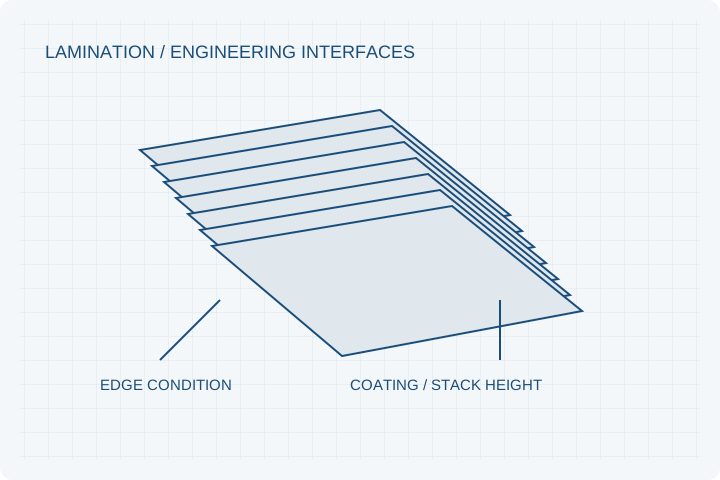
Laser-cut prototypes can reduce the need for dedicated stamping tooling during early design work, but edge condition and loss behavior need review. Spiral stacks, segmented stacks and stamped parts are different routes with different fixtures and process risks.
Keep a measurable interface contract
For a supplied stator, specify whether acceptance occurs before or after impregnation and machining. For a rotor, define magnetization, balance state and reference datums. Measurements on separate parts do not necessarily describe the final assembly.
Protect the design handoff
Request an NDA before confidential files are exchanged. Upload a non-confidential envelope or an NDA PDF for the first conversation. Once the agreement is signed, include its reference with the controlled drawing package.
Prepare your RFQ
The inputs that make a useful review.
| Input | What to send | Why it matters |
|---|---|---|
| Controlled package | 2D/3D files with revision, units and datums | Prevents conflicting drawings from defining the same part. |
| Materials and substitutions | Steel, magnet, wire, adhesive and resin requirements | Defines when an alternative needs engineering approval. |
| Inspection plan | Critical characteristics, limits and measurement method | Turns functional expectations into inspectable acceptance. |
| Commercial scope | Prototype quantity, volume forecast and tooling ownership | Separates recurring unit cost from engineering and NRE. |
For confidential geometry, complete the NDA review before disclosure.
Continue your review
Related engineering programs
Questions before you specify
Do you take over electromagnetic design ownership?
Only where that responsibility is explicitly included in the agreed scope. Build-to-print manufacture follows the released customer specification.
Can materials be substituted to shorten lead time?
Proposed alternatives require approval against magnetic, thermal, mechanical and process requirements. A similar grade name is insufficient.
What is needed for a useful quotation?
Drawing revision, material requirements, sample and annual quantities, acceptance tests, delivery scope and any existing tooling constraints.
From constraint to a controlled brief
Bring the dimensions.
Define the evidence.
Request an engineering review ↗Prototype planning target: 3–5 weeks for suitable programs after DFM, material availability and drawing freeze. Quotation confirms feasibility, cost and schedule.