
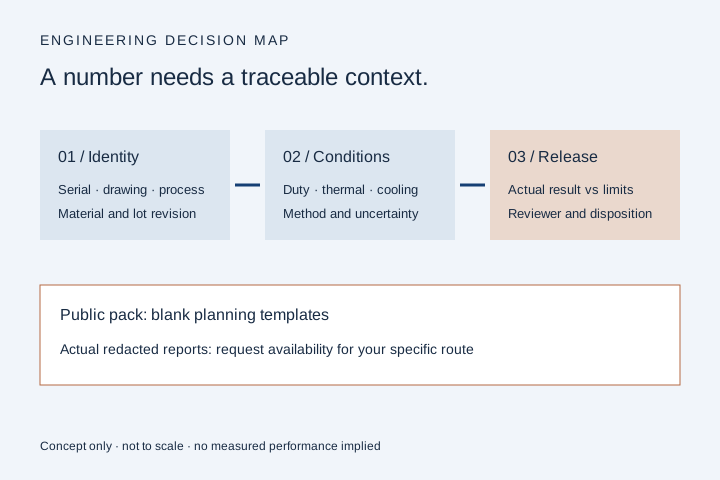
Blank planning documents only. No actual OQC/dyno measurements are available in this public pack. Request an authentic redacted record ↗
This is a blank acceptance template, not a test result
No sample production measurements, accredited laboratory results or serialized dyno records are published in this pack. Download the blank CSV to draft acceptance requirements, or request an actual redacted record for the specific manufacturing route. Availability, permission to share and comparability must be confirmed. A completed template does not become evidence until it is tied to a real part, method and authorized release.
A report starts with traceability and test conditions
A traceable report lets an engineer decide whether a number belongs to the proposed assembly and operating point. Keep the raw-data filename, instrument/calibration references, software/configuration revision and any deviations next to the result. Redaction can remove customer identity, but removing every drawing revision or operating condition may make the record technically unusable.
| Report field | What to record | Why it changes interpretation |
|---|---|---|
| Identity | Part and serial/lot, drawing/material/process revisions | Confirms the tested configuration |
| Conditions | Ambient, winding/coolant temperatures, mounting and supply | Prevents comparisons across incompatible duty states |
| Method | Instrument IDs, calibration dates, procedure and uncertainty | Defines how the result was obtained |
| Release | Specified limits, result, disposition, reviewer and date | Separates a recorded number from an accepted part |
IQC / IPQC / OQC: assign ownership before measuring
Use the following as an editable planning matrix. No row implies a test is included in a quotation. Define the method, numerical acceptance limits, test frequency and responsibility in the purchase specification.
| Gate | Candidate records | Scope question |
|---|---|---|
| IQC — incoming | Magnet grade/lot, electrical steel or SMC identity, coating/resin documents | Which properties require certificates and which need incoming verification? |
| IPQC — in process | Core density/stack, winding resistance, bonding/potting revision, runout | Which features become inaccessible after assembly? |
| OQC — outgoing | Final dimensions, phase balance, insulation, back-EMF and agreed performance points | Which tests are per unit, sampled or design qualification only? |
| System validation | Duty-cycle temperature, torque/speed, controller and installed gap behavior | Who owns the integrated assembly and the final release? |
Dyno and back-EMF records need defined electrical boundaries
For efficiency, state whether input is DC power at inverter input or three-phase motor electrical power; the former includes drive losses. Record synchronized electrical and mechanical measurements at steady conditions. Back-EMF needs open-circuit connection, mechanical rpm, waveform capture, line/phase and peak/RMS definitions plus temperature. A graph without these conditions cannot substantiate a winding match.
| Measurement | Required context | Avoid this shortcut |
|---|---|---|
| Torque / speed / power | Same operating point, sensor range/zero, thermal state and duration | Multiplying unrelated peak torque and maximum speed as a rating |
| Efficiency | Power boundary, synchronized acquisition and uncertainty | Mixing motor-only output/input with system-level input |
| Cogging / starting torque | Unenergized state, angle resolution, bearing/seal/load contribution | Calling every measured starting resistance cogging |
| Insulation / PD | Agreed insulation system, inverter stress, procedure and acceptance criterion | Deriving the test voltage solely from an 800 V bus label |
Worked record structure: leave unknowns blank
Example of structure only: part revision [blank]; serial [blank]; speed [blank rpm]; torque [blank Nm]; winding temperature [blank °C]; cooling inlet/flow [blank]; measured input/output [blank W]; limit [blank]; disposition [blank]. The CSV deliberately contains no measured result or pass status. A buyer should reject a quotation attachment that fills such fields with generic illustrative numbers while presenting it as an actual outgoing report.
Request a useful redacted pack
Name the route you are considering, part family, duty point and document purpose. Ask which records are authentic examples, which belong to a different configuration, and which will be produced only after a paid sample build. If proprietary data cannot be shared before NDA, agree the confidentiality process first. The inquiry link on this page preserves this acceptance-pack context. No response or agreement is implied by opening a contact channel.